A Post Industrial Picturesque
Brampton Museum, Newcastle-Under-Lyme, ST5 0QP
28 June – 7 September
This exhibition presents a range of new works from over 30 artists which explore the subject of industrial ruins; their allure, fascination and histories.
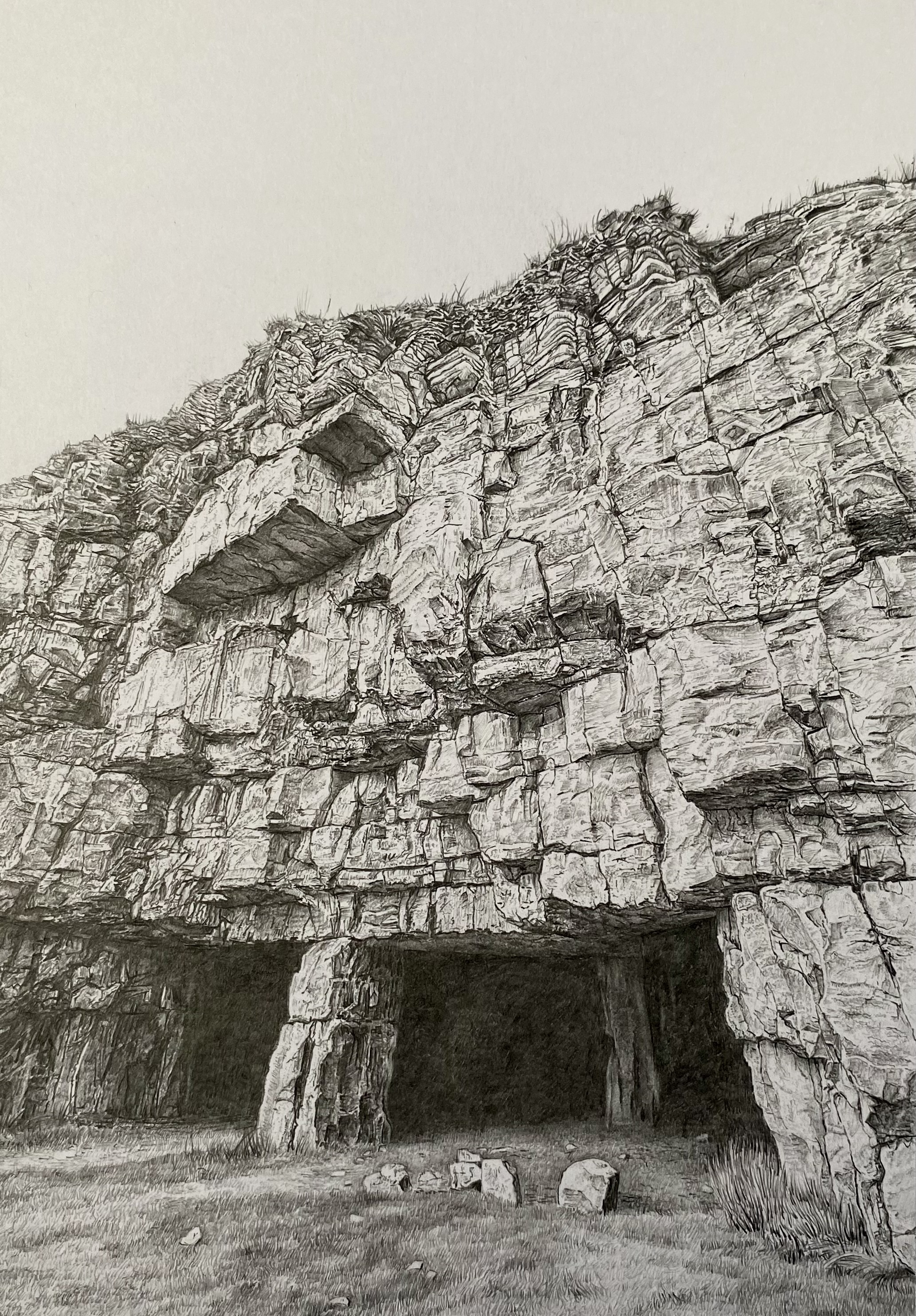
Winspit Quarry has never failed to hold my fascination or intrigue, returning repeatedly over thirty years. The weight of the limestone and force of the sea has shaped a place which seems unyielding, permanent and fixed yet each visit reveals small, barely-imperceptible shifts.
Shrimp Bed, Under Picking, Pond Freestone, Titanites, Blue Bed, The Spangle, Portland Chert.
I am aware that in the space between each visit, I am changed and I return different to the last visit; the place then holds different questions. Each time, there are different reasons for visiting but I can never really know quite what it is that has led me there. But the pull remains.
For ‘Trace’, I deliberately avoided any built remains, focussing on the absent space created by the quarry galleries. I wanted something which had echoes of human activity, at the intersection of industry, abandonment, and nature recovery. How many of the marks in this image remain from human endeavour and how much is natural, returning even?
Exhibition Catalogue Statement
In the eighteenth century there were more than two hundred quarries in Purbeck, Dorset. ‘Purbeck marble’ was quarried from the cliff face via caves and tunnels. The stone was loaded onto boats by crane and taken to London. The return journeys brought building masonry back to the area, acting as ballast, with many architectural features from the capital re-sited in Swanage. In their new surreal seaside location, they provided inspiration for artist Paul Nash, who lived in Swanage for a short while.
Winspit was used as a stone quarry until 1940. Remnants of buildings and loading ramps still linger, but the ‘absent space’ of the quarry caves and tunnels provide an enigmatic trace of activity, now home to rare Bat populations.
“A ruin is more than a collection of debris. It is a place with its own individuality, charged with its own emotion, atmosphere and drama, of grandeur, of nobility and of charm. These qualities must be preserved as carefully as the broken stones which are their embodiment. When we contemplate ruins, we contemplate our own future and the inevitability of human progress over time.
Ruins can inspire a wide variety of responses that includes a curious magnetism. There is a perverse pleasure perhaps even fear in the contemplation of decay. One attraction is their sense of transience and vulnerability, antipathy to permanence which is an existential necessity for humanity. They offer the prospect of oblivion – a perfect metaphor for the futility of mortal pride. The bare vestiges contrast with the original use and purpose of the structure, for the interest in ruins rarely equates to its reality. Ruins do not speak; we speak for them – they are a sounding board for the emotions.
Ruins succumb to virulent and wild nature which appears almost as an instrument of revenge. The promise of the inevitable victory of nature, free and democratic, over the tyranny of structures and what they embodied, especially some industrial ruins, symbolises the contest between the individual and the universe. The embrace of nature fills us with joy for no ruin can be suggestive to the viewer’s imagination unless in dialogue with the forces of nature – visibly alive and dynamic in opposition to the death of the structure. When ruins are cleaned up and deprived of nature’s magic wand, they can appear lonely, sinister, and dislocated from place and time.
Memories of organised human activity and lives invested in the extraction, movement, manipulation and transformation of materials.
In a way, there is also something cleansing or neutralising in the encroachment of nature and the dissolution of human made processes by natural growth, decay and absorption.
Industrial ruins, in some cases, emphasise contrast between the urgency, noise and ‘brutality’ of the forces that were managed within these spaces and the silent invasion of natural processes.”
Tim Craven and Phil Smith
 paul newman