A Post Industrial Picturesque

A Post Industrial Picturesque

Brampton Museum, Newcastle-Under-Lyme, ST5 0QP

28 June – 7 September 

This exhibition presents a range of new works from over 30 artists which explore the subject of industrial ruins; their allure, fascination and histories.

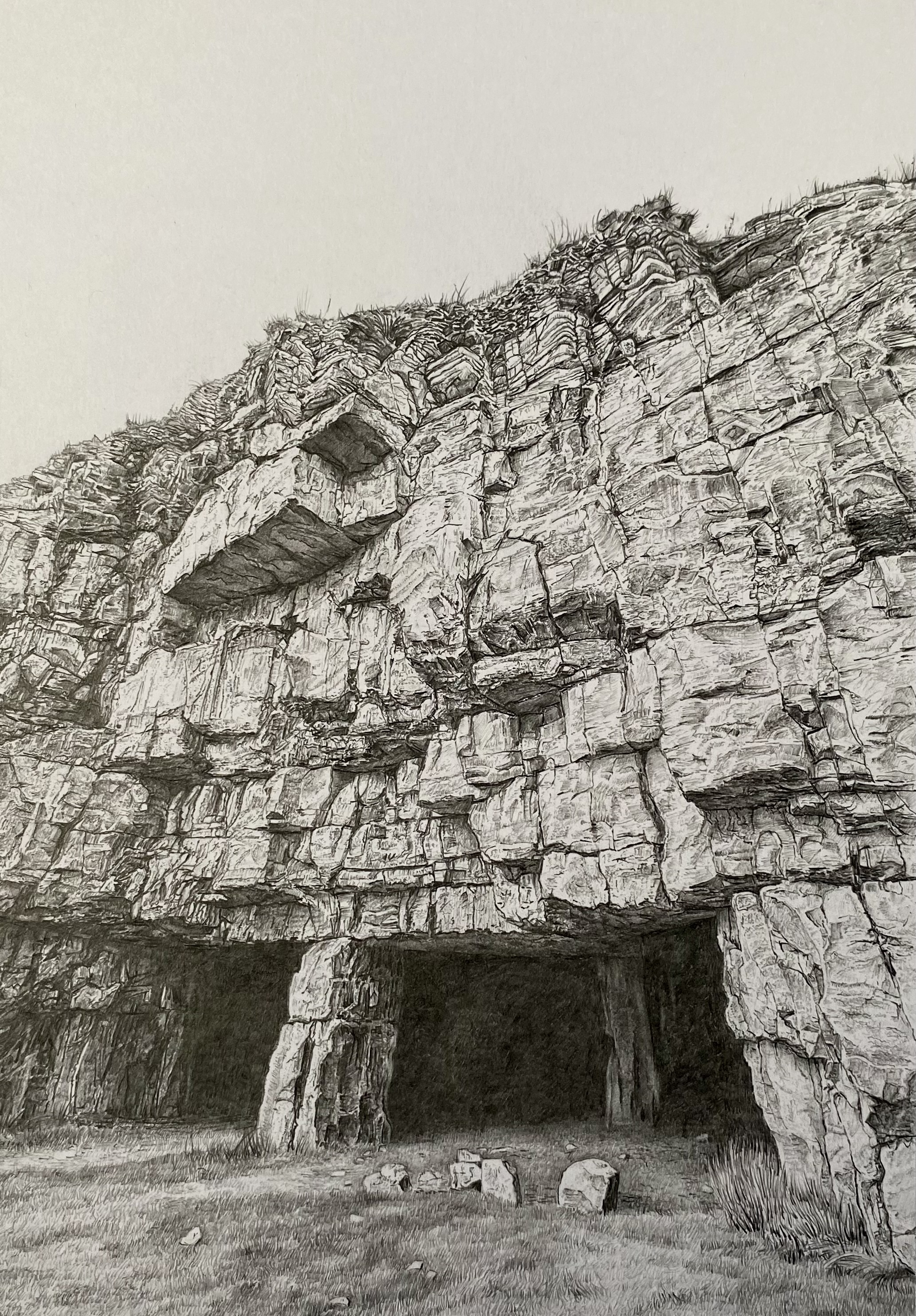
Winspit Quarry has never failed to hold my fascination or intrigue, returning repeatedly over thirty years. The weight of the limestone and force of the sea has shaped a place which seems unyielding, permanent and fixed yet each visit reveals small, barely-imperceptible shifts. 

Shrimp Bed, Under Picking, Pond Freestone, Titanites, Blue Bed, The Spangle, Portland Chert.

I am aware that in the space between each visit, I am changed and I return different to the last visit; the place then holds different questions. Each time, there are different reasons for visiting but I can never really know quite what it is that has led me there. But the pull remains.

For ‘Trace’, I deliberately avoided any built remains, focussing on the absent space created by the quarry galleries. I wanted something which had echoes of human activity, at the intersection of industry, abandonment, and nature recovery. How many of the marks in this image remain from human endeavour and how much is natural, returning even?

Exhibition Catalogue Statement

In the eighteenth century there were more than two hundred quarries in Purbeck, Dorset. ‘Purbeck marble’ was quarried from the cliff face via caves and tunnels. The stone was loaded onto boats by crane and taken to London. The return journeys brought building masonry back to the area, acting as ballast, with many architectural features from the capital re-sited in Swanage. In their new surreal seaside location, they provided inspiration for artist Paul Nash, who lived in Swanage for a short while.

Winspit was used as a stone quarry until 1940. Remnants of buildings and loading ramps still linger, but the ‘absent space’ of the quarry caves and tunnels provide an enigmatic trace of activity, now home to rare Bat populations.
An exploration of the reasons for the allure of places such as these is best left to the curators:

A ruin is more than a collection of debris. It is a place with its own individuality, charged with its own emotion, atmosphere and drama, of grandeur, of nobility and of charm. These qualities must be preserved as carefully as the broken stones which are their embodiment. When we contemplate ruins, we contemplate our own future and the inevitability of human progress over time.

Ruins can inspire a wide variety of responses that includes a curious magnetism. There is a perverse pleasure perhaps even fear in the contemplation of decay. One attraction is their sense of transience and vulnerability, antipathy to permanence which is an existential necessity for humanity. They offer the prospect of oblivion – a perfect metaphor for the futility of mortal pride. The bare vestiges contrast with the original use and purpose of the structure, for the interest in ruins rarely equates to its reality. Ruins do not speak; we speak for them – they are a sounding board for the emotions.

Ruins succumb to virulent and wild nature which appears almost as an instrument of revenge. The promise of the inevitable victory of nature, free and democratic, over the tyranny of structures and what they embodied, especially some industrial ruins, symbolises the contest between the individual and the universe. The embrace of nature fills us with joy for no ruin can be suggestive to the viewer’s imagination unless in dialogue with the forces of nature – visibly alive and dynamic in opposition to the death of the structure. When ruins are cleaned up and deprived of nature’s magic wand, they can appear lonely, sinister, and dislocated from place and time. 

Memories of organised human activity and lives invested in the extraction, movement, manipulation and transformation of materials.

In a way, there is also something cleansing or neutralising in the encroachment of nature and the dissolution of human made processes by natural growth, decay  and absorption.

Industrial ruins in some cases, emphasise contrast between the urgency, noise and ‘brutality’ of the forces that were managed within these spaces and the silent invasion of natural processes.”

Tim Craven and Phil Smith

Every Step of the Way

Making the Spot – a walk in Longing and Loss

In August 2024, I walked a 10 mile section of the South Downs Way for an Arts and Place project, Every Step of the Way, where artists have been invited to respond to allocated sections of the entire 100 mile route. The exhibition runs at The Arc, Winchester, 4 April – 16 July 2025 and at The Weald and Downland Living Museum 22 September – 8 February 2026.

Many paths, and routes, are taken in life. Some are slower, but there is always direction, progress intentional or not, however a terminus might be determined and no matter the diversions or distractions along the way.

The anticipation of walking a section of the South Downs way held a deep appeal. Unfamiliar territory, a time to explore where ideas lurk and spirits dwell. At the tail end of summer, and with autumn soon within reach, tracking the bone crest of chalk between Upper Beeding and Washington under an aching heat. Red Kites patrol the fields in the lea of the southern slopes between Steyning Bowl, looking towards Cissbury Ring. Scorched grass, bleached tracks, a route itching with dryness. Two Ashes, fanning out, animated structures but alone in the corner of a field. Poppies adding dashes of blood in the stillness. 

There was little of note on the Downs that day; the earth lapsing and gasping, demise, silenced song, numbness, a succumbing, a stupor. Lurking to the north, Gilbert White’s presence, just a veil over the hangars and downs. But a strong bond – Familial roots and routes.

As well as the linear route, established over millennia, there are the other dimensions to walking. It is of a comfort to walk with just a simple objective – to reach the end of that day’s section, under an infinite sky. And something other, less tangible; space in which to ponder on the way and derive a reaction – to gather clear observations and thoughts, to take them home and create a response. 

Chanctonbury Ring, study #6

In unfamiliar territory, looking for something relatable or at least subconsciously recognisable to respond to. The sublime will always come calling even in the depths of distraction or abandonment; unpredictable, surprising, shifting.

Chanctonbury Ring, a fine standing of Beech bound within a sacred enclosure, sat at the end of the day. The blackness of the tree shade, thrust deeper by the striking light, creating contrast in the shelter – a mark on a gently sloping shoulder of chalk. 

Exhibition notes: 

Ten works were produced in response to walking the Way, a personal record of a distinct moment. The effort of walking creates a sense of achievement; progression, as with any journey physical or otherwise. Exploration and desire can sometimes be objective, clear, and purposeful, sometimes not so, ponderous, circular, reflective. 

At Chanctonbury Ring: Figures walking towards each other, or parting? Life and death held in the Beeches, regenerating. Nearby, Ashes with dieback line the Way.

Hogback Hills

I am one of 21 invited artists contributing to an exhibition in summer 2024 at the Sidney Nolan Trust in Presteigne which explores the geological, ecological and human story of Hanter Hill, Worsell Wood and Stanner Rocks. 

The area, on the mid-Wales/England border, contains remnants of Pre-Cambrian volcanoes and some of the oldest rocks in Wales. It’s a beautiful location, and Stanner Rock is home to the elusive Radnor Lily.

I spent the first weekend of 2024 walking in Worsell Woods as well as Stanner Rocks, exploring as much as possible. With limited time, it was important to get a sense of the ecology of this particular area and the ‘feel’ of the hills and how the underlying geology informs what lives on the surface. I wanted to discover the different inhabitants in this area, in a variety of habitats including mixed woodland with some striking examples of oak, ash and birch.

I have had a long interest in the work of naturalist Gilbert White and prior to visiting Stanner, I had visited his home in Selborne on the South Downs. His important work observing and documenting birds, their behaviour and associated ecology have inspired many. During lockdown I became especially interested in the birdlife of the surrounding woods at home and in particular, how I encountered, observed and recorded them; not just their identification but also their behaviours. In short, I noticed ‘more’. I thought about how we observe and record – what do we actually notice, and what can we learn and retain, especially when walking? 

This turned my thoughts to our relationship to what we refer to as ‘nature’ and the fragility of ecological systems. Walking the Hogback Hills reveals the eons of deep time and relative permanence expressed in the geological make up of the Stanner complexes expressed against the short, thin veil of our own existence and impact we are enacting on the planet.

A series of bird drawings will form part of the exhibition which runs from 18th July – 28th September.

Hogback Hills – Sidney Nolan Trust, The Rodd, Presteigne, LD8 2LL

Sidney Nolan Trust

Paradise Found- New Visions of The Blackdown Hills

Thelma Hulbert Gallery- 18 March- 3 June

Curated by Tim Craven, Sandra Higgins and Fiona McIntyre

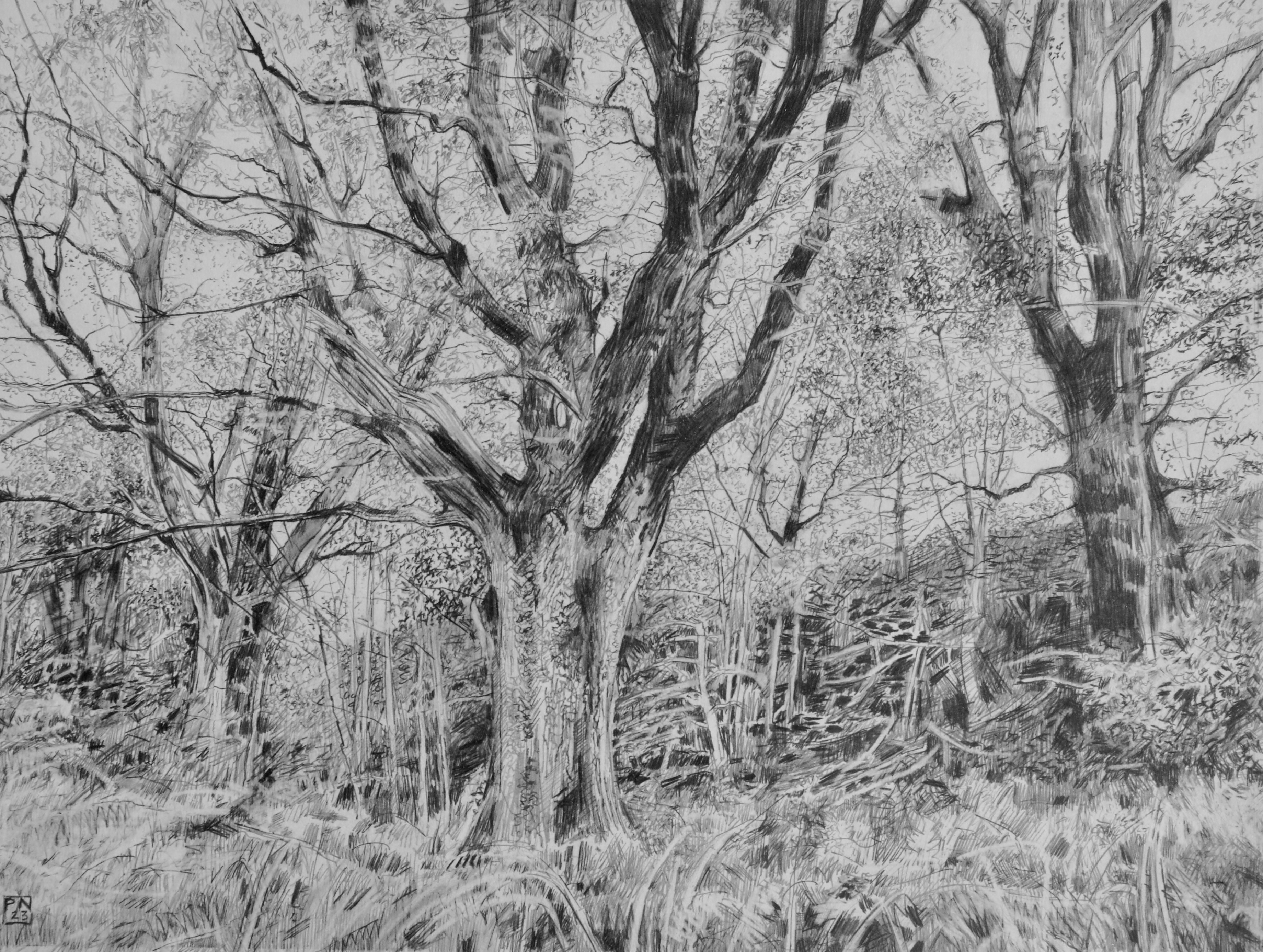
Edge of the Wood, Applehayes- Looking Back  Graphite on Bristol Board, 2023, 18 x 24 cm

Looking for Spencer Gore

Many times I have taken the beech-lined road which runs along the Blackdown Hills on the southern edge of Taunton Vale- but never properly ventured into the nearby cluster of valleys and knuckle of accompanying hills which knit together in the hinterland between Somerset and Devon.

I was one of 36 artists invited to make a contemporary response to works created by members of The Camden Town Group who stayed in the area in the early 1900’s. My piece was Edge of the Wood, Applehayes by Spencer Gore.

Wanting to interpret the brief as carefully (yet creatively) as possible, the question was- edge of which wood? The first thing to notice when leaving the main road to drive down into the valleys around Clayhidon is the way in which the area is circuited and protected by woods, an abundance of woodland on the surrounding high ground, with fingers of hedgerows making forays down into the valleys. Finding the location of Gore’s painting was going to be a challenge.

The Cinder Path by Gore has remained a favourite painting since first seeing it in The Ashmolean many years ago. I was pleased to have the opportunity to delve into a location, to understand its nature,  the way it had been painted and maybe to learn more about Gore himself. It had seemed hard to find information about Gore but the book Fragile Beauty by Richard Emeny was helpful in locating Gore and the spots in which he had stood.

The first visit was in heavy rain, and we parked outside Applehayes. Looking at the painting Across Wiltown Valley Towards Ringdown provided the first clues to Gore’s footsteps; the profile of Ringdown is still distinct and a small, lone barn, isolated in a field on the hillside above the lakes, made the location of this painting easy to identify. Emeny states that:

“Gore’s pictures… were mostly executed within a few yards of Applehayes. Their titles may be generic, such as West County Landscape, but their subjects are the fields, hills and hedgerows of Clayhidon Parish, many being clearly identifiable if anyone cares to walk the lanes, so little has the landscape altered.”

The rain came hard and a plan to walk further was shelved, taking refuge in the beeches of Ringdown itself. These seemed intriguing, a beautiful play of light underneath the ebbing autumn canopy, and an idea for a picture formed but this was too far from the brief, and not even the same painting as Edge of the Wood, trying to make it ‘fit’ wasn’t good enough. The ancient lanes approaching Ringdown with their fine ancient oaks and abandoned buildings were appealing and attractive, but we were moving further away from Gore and the painting I was meant to respond to. 

Another visit was planned, delving back into Fragile Beauty, re-studying the paintings by Gore and going back to Richard’s statement. I realised that this revealed more than I thought. Gore’s pictures were literally executed within yards of Applehayes, so there was no need to plan extensive walks to get the feel of this ‘place’, which is my usual approach, but merely to radiate out from Applehayes and we might find the spot. 

Returning later in a very mild autumn, the trees were still holding on to summer although the colours of the canopies were slowly yielding to the turn of the year. Something felt different this time. We’d realised from going back to the book that the latter part of Richard’s statement, about the fields, hills and hedgerows being clearly identifiable, might be the thing to focus on and help find the location we were seeking. So much would have shifted over 100 years, but what remained? Driving past Applehayes, we soon found the viewpoint for Landscape Near Applehayes, with the summit of Ringdown Hill distinct but from a different angle to last time. It was the roof of  Lear’s Farm (?), its distinctive length and colour, along with an exposed triangle of whitewashed wall which had been recorded by Gore’s brushworks and was clearly identified. The feeling of being in the same spot of a second painting gave a sense that we might be able to find the other pictures, including Edge of the Wood.

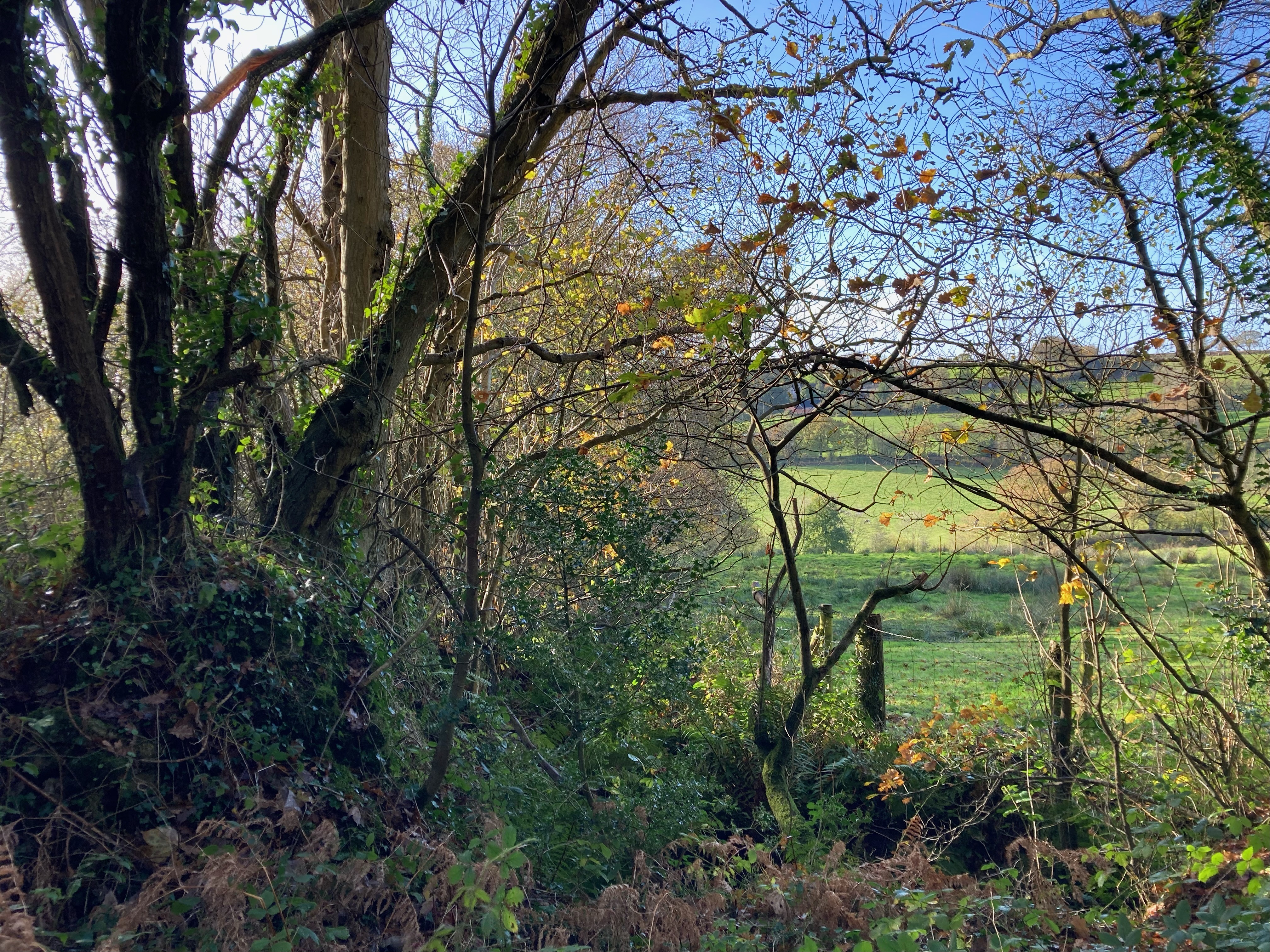
Driving back up to Applehayes, we parked again and set out across the fields behind to walk a modest circuit which would take us past a small wood. After crossing the fields, we returned past another farm to then change direction along a small ridge with woodland. We were looking for a flat skyline, with the delineation of field systems and hedgerows, but unsure of what the wood itself might look like after 100 years. We felt that we might be in the right area and soon noticed that the younger wood, consisting of birch and hazel gave way to oaks and other more mature trees. We quickly realised that we were looking across to a flat skyline across the valley, slightly obscured by trees, but there it was- similar field patterns in the distance and the edge of the wood in the foreground. The field shapes were almost identical to those depicted in the painting and although the wood was not quite how we expected it, the boundary and light seemed to all suggest that this was the spot. The longer we looked, the more confident we felt that we were in the right spot. The sense of relief was huge! Now, I could focus on how to interpret the location for my own piece.

Where Gore stood to paint ‘Edge of the Wood, Applehayes’

As Gore worked in colour and my work is monochrome, I felt that a different interpretation was really needed. If I was going to spend time on this, I needed something that would excite me. The trees in Gore’s picture were not really playing with the light as I would like, and Gore’s composition, although working well with his palette, was structurally uninteresting. However, a couple of ideas started to form. One would be to execute a quick study using a looser way of working which I had adopted during lockdown- which gave a sense of energy and movement. The other idea was to turn my back on the scene, to go to the oaks which stood behind us and work with those. The oaks felt precious, semi wild and would have sheltered Gore as he painted the scene. I could feel the sense that this was ‘right’ starting to flow. It would be two pictures, one ‘me’ and one ‘him’, back and forth across a century.

Paradise Found opens on 18 March with a preview

The Camden Town Group in Context

Thelma Hulbert Gallery- Paradise Found

#Art #ArtExhibition #ArtCollector #Nature #Environment #BlackdownHills #Devon #Somerset #Painting #Printmaking #Drawing #SpencerGore #Arboreal #Trees #Woodland #Wildlife #Ecology #Walking #SouthWestEngland #CamdenTownGroup #ArtHistory

Introduction

I am a graphic fine artist who works exclusively in graphite. Extensive walking, close observation and research about land, place and what we call ‘nature’ are integral to my practice.

I have exhibited at the Royal West of England Academy and with the Society of Graphic Fine Art in London as well as various Open exhibitions in South West England including RWA Drawn, Bath Society of Artists Annual Opens and Somerset Art Weeks events. I also show extensively with The Arborealists.

unnamed-2
Drawing in Horner Woods (photo Davina Jelley)

In my curatorial work, I have organised many exhibitions including ‘The Transformed Land’, which collected work from various artists interested in place- some who frequently return to the same place, others who are visitors, some who are residents, and some who are creators of imagined places.

Here, you can find information about my work, exhibitions and news with an insight into my process through ‘walking and writing’. Cards and reproductions of my work are available under ‘purchase’.

I am a member of The Arborealists and a Member of The Society of Graphic Fine Art. I also work as the Creative Director for Dorset Visual Arts

The Rewilding Britain Garden for Urquhart & Hunt, Chelsea Flower Show 2022