A Post Industrial Picturesque

A Post Industrial Picturesque

Brampton Museum, Newcastle-Under-Lyme, ST5 0QP

28 June – 7 September 

This exhibition presents a range of new works from over 30 artists which explore the subject of industrial ruins; their allure, fascination and histories.

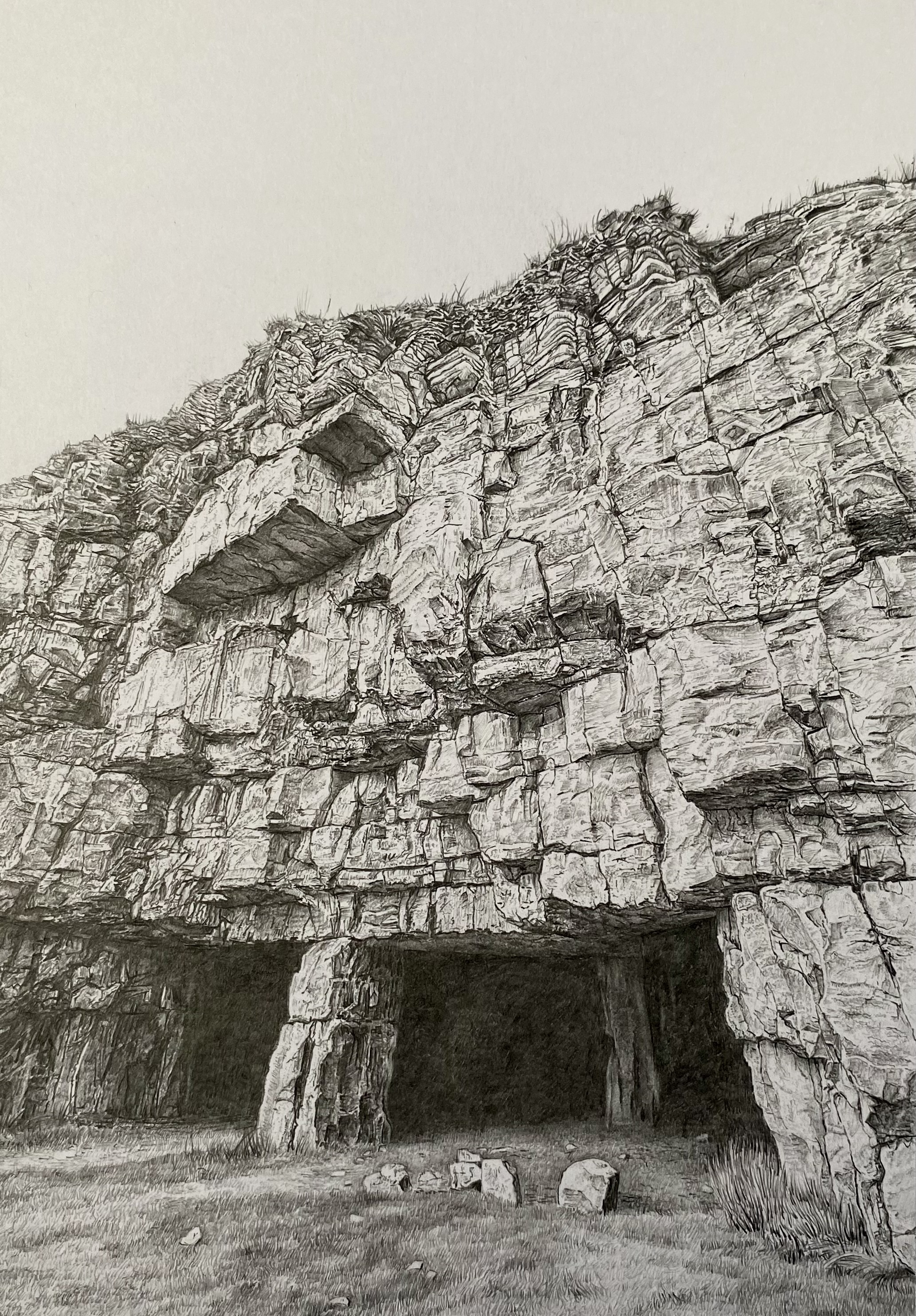
Winspit Quarry has never failed to hold my fascination or intrigue, returning repeatedly over thirty years. The weight of the limestone and force of the sea has shaped a place which seems unyielding, permanent and fixed yet each visit reveals small, barely-imperceptible shifts. 

Shrimp Bed, Under Picking, Pond Freestone, Titanites, Blue Bed, The Spangle, Portland Chert.

I am aware that in the space between each visit, I am changed and I return different to the last visit; the place then holds different questions. Each time, there are different reasons for visiting but I can never really know quite what it is that has led me there. But the pull remains.

For ‘Trace’, I deliberately avoided any built remains, focussing on the absent space created by the quarry galleries. I wanted something which had echoes of human activity, at the intersection of industry, abandonment, and nature recovery. How many of the marks in this image remain from human endeavour and how much is natural, returning even?

Exhibition Catalogue Statement

In the eighteenth century there were more than two hundred quarries in Purbeck, Dorset. ‘Purbeck marble’ was quarried from the cliff face via caves and tunnels. The stone was loaded onto boats by crane and taken to London. The return journeys brought building masonry back to the area, acting as ballast, with many architectural features from the capital re-sited in Swanage. In their new surreal seaside location, they provided inspiration for artist Paul Nash, who lived in Swanage for a short while.

Winspit was used as a stone quarry until 1940. Remnants of buildings and loading ramps still linger, but the ‘absent space’ of the quarry caves and tunnels provide an enigmatic trace of activity, now home to rare Bat populations.
An exploration of the reasons for the allure of places such as these is best left to the curators:

A ruin is more than a collection of debris. It is a place with its own individuality, charged with its own emotion, atmosphere and drama, of grandeur, of nobility and of charm. These qualities must be preserved as carefully as the broken stones which are their embodiment. When we contemplate ruins, we contemplate our own future and the inevitability of human progress over time.

Ruins can inspire a wide variety of responses that includes a curious magnetism. There is a perverse pleasure perhaps even fear in the contemplation of decay. One attraction is their sense of transience and vulnerability, antipathy to permanence which is an existential necessity for humanity. They offer the prospect of oblivion – a perfect metaphor for the futility of mortal pride. The bare vestiges contrast with the original use and purpose of the structure, for the interest in ruins rarely equates to its reality. Ruins do not speak; we speak for them – they are a sounding board for the emotions.

Ruins succumb to virulent and wild nature which appears almost as an instrument of revenge. The promise of the inevitable victory of nature, free and democratic, over the tyranny of structures and what they embodied, especially some industrial ruins, symbolises the contest between the individual and the universe. The embrace of nature fills us with joy for no ruin can be suggestive to the viewer’s imagination unless in dialogue with the forces of nature – visibly alive and dynamic in opposition to the death of the structure. When ruins are cleaned up and deprived of nature’s magic wand, they can appear lonely, sinister, and dislocated from place and time. 

Memories of organised human activity and lives invested in the extraction, movement, manipulation and transformation of materials.

In a way, there is also something cleansing or neutralising in the encroachment of nature and the dissolution of human made processes by natural growth, decay  and absorption.

Industrial ruins in some cases, emphasise contrast between the urgency, noise and ‘brutality’ of the forces that were managed within these spaces and the silent invasion of natural processes.”

Tim Craven and Phil Smith

Witness

The Arborealists – Ancient Trees

Nature in Art, Twigworth, Gloucester GL2 9PA 10th Sept – 13th Oct

We live in a belt of mixed woodland, both public and private, on the north Dorset border, which contains fine examples of veteran and ancient oak. The tree I have depicted for this exhibition is no more. It fell during Storm Eunice on 18th February 2022, which set a new record for the fastest wind gust recorded in England (122 mph). To witness the exact moment of the end of a 400 year-old tree, at the mercy of such energy, was surreal, shocking and bewildering.

The tree stood just a few yards from home, and we feel the loss of this friend daily.

Having already made work about two of Dorset’s most famous ancient trees – the Silton Oak (Wyndham’s Oak), near Gillingham, and the Martyr’s Tree at Tolpuddle – I wanted to work with another Dorset tree that captured the essence of it’s ancient companions, something with a character and presence.

The Witness Oak was on it’s way to ancient status, with neighbouring park and woodland oaks rich in variety, form and shape, including one just a few yards from home which has been estimated to be at least 500 years old. There is also a much older ‘big belly’ oak in Sherborne Park Camp, which is certainly ancient judging by its girth and form. Studying these species on daily walks, I have become more aware of some of the challenges facing these majestic lifeforms including pressure from land use, disease and climate change. We confer special status on ancient trees but in this new work I wanted to convey a sense of what is inherently special or unique in all lifeforms.

Thanks to people like Julian Hight and George Peterken, I have become increasingly interested in different aspects of tree ecology, folklore and land management; this, in turn, now has an effect on my own practice. I wanted to use my involvement in this project to acknowledge the fragile resource of our remaining ancient trees. Will the effects of human activity and events such as increased storms lead to more trees not making it to their ancient years?

Witness, Graphite on Bristol Board, 2024

Paradise Found- New Visions of The Blackdown Hills

Thelma Hulbert Gallery- 18 March- 3 June

Curated by Tim Craven, Sandra Higgins and Fiona McIntyre

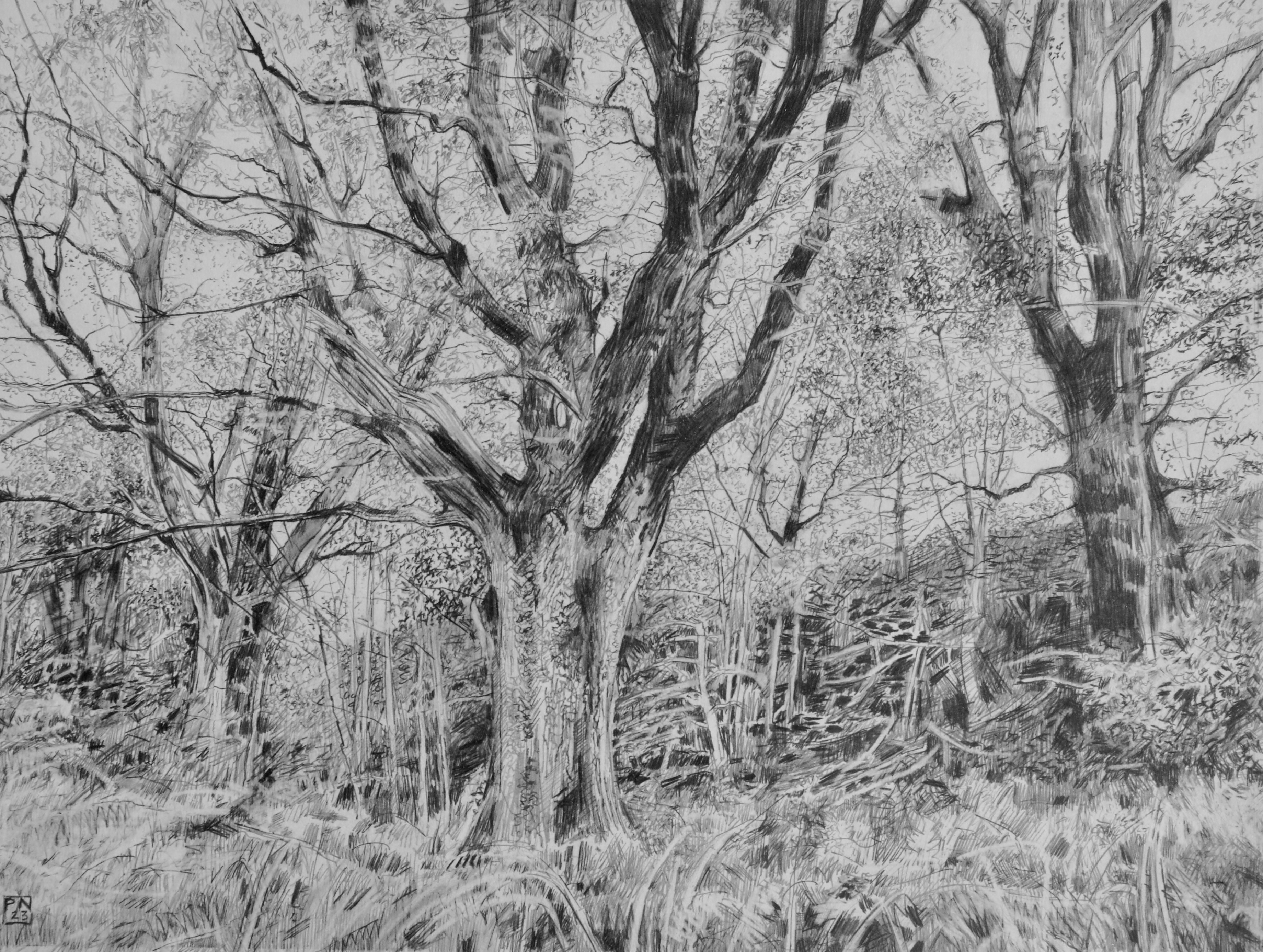
Edge of the Wood, Applehayes- Looking Back  Graphite on Bristol Board, 2023, 18 x 24 cm

Looking for Spencer Gore

Many times I have taken the beech-lined road which runs along the Blackdown Hills on the southern edge of Taunton Vale- but never properly ventured into the nearby cluster of valleys and knuckle of accompanying hills which knit together in the hinterland between Somerset and Devon.

I was one of 36 artists invited to make a contemporary response to works created by members of The Camden Town Group who stayed in the area in the early 1900’s. My piece was Edge of the Wood, Applehayes by Spencer Gore.

Wanting to interpret the brief as carefully (yet creatively) as possible, the question was- edge of which wood? The first thing to notice when leaving the main road to drive down into the valleys around Clayhidon is the way in which the area is circuited and protected by woods, an abundance of woodland on the surrounding high ground, with fingers of hedgerows making forays down into the valleys. Finding the location of Gore’s painting was going to be a challenge.

The Cinder Path by Gore has remained a favourite painting since first seeing it in The Ashmolean many years ago. I was pleased to have the opportunity to delve into a location, to understand its nature,  the way it had been painted and maybe to learn more about Gore himself. It had seemed hard to find information about Gore but the book Fragile Beauty by Richard Emeny was helpful in locating Gore and the spots in which he had stood.

The first visit was in heavy rain, and we parked outside Applehayes. Looking at the painting Across Wiltown Valley Towards Ringdown provided the first clues to Gore’s footsteps; the profile of Ringdown is still distinct and a small, lone barn, isolated in a field on the hillside above the lakes, made the location of this painting easy to identify. Emeny states that:

“Gore’s pictures… were mostly executed within a few yards of Applehayes. Their titles may be generic, such as West County Landscape, but their subjects are the fields, hills and hedgerows of Clayhidon Parish, many being clearly identifiable if anyone cares to walk the lanes, so little has the landscape altered.”

The rain came hard and a plan to walk further was shelved, taking refuge in the beeches of Ringdown itself. These seemed intriguing, a beautiful play of light underneath the ebbing autumn canopy, and an idea for a picture formed but this was too far from the brief, and not even the same painting as Edge of the Wood, trying to make it ‘fit’ wasn’t good enough. The ancient lanes approaching Ringdown with their fine ancient oaks and abandoned buildings were appealing and attractive, but we were moving further away from Gore and the painting I was meant to respond to. 

Another visit was planned, delving back into Fragile Beauty, re-studying the paintings by Gore and going back to Richard’s statement. I realised that this revealed more than I thought. Gore’s pictures were literally executed within yards of Applehayes, so there was no need to plan extensive walks to get the feel of this ‘place’, which is my usual approach, but merely to radiate out from Applehayes and we might find the spot. 

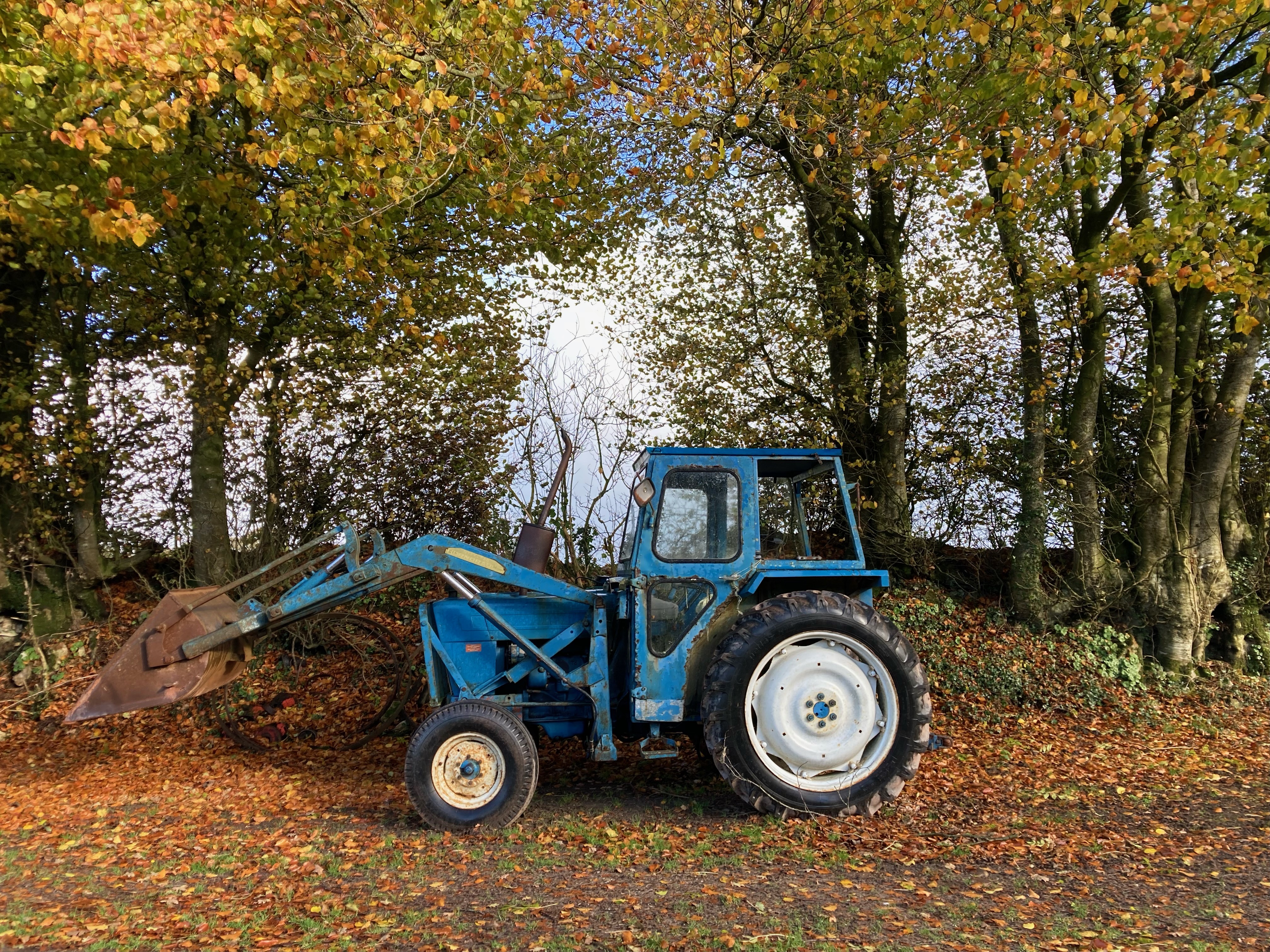
Returning later in a very mild autumn, the trees were still holding on to summer although the colours of the canopies were slowly yielding to the turn of the year. Something felt different this time. We’d realised from going back to the book that the latter part of Richard’s statement, about the fields, hills and hedgerows being clearly identifiable, might be the thing to focus on and help find the location we were seeking. So much would have shifted over 100 years, but what remained? Driving past Applehayes, we soon found the viewpoint for Landscape Near Applehayes, with the summit of Ringdown Hill distinct but from a different angle to last time. It was the roof of  Lear’s Farm (?), its distinctive length and colour, along with an exposed triangle of whitewashed wall which had been recorded by Gore’s brushworks and was clearly identified. The feeling of being in the same spot of a second painting gave a sense that we might be able to find the other pictures, including Edge of the Wood.

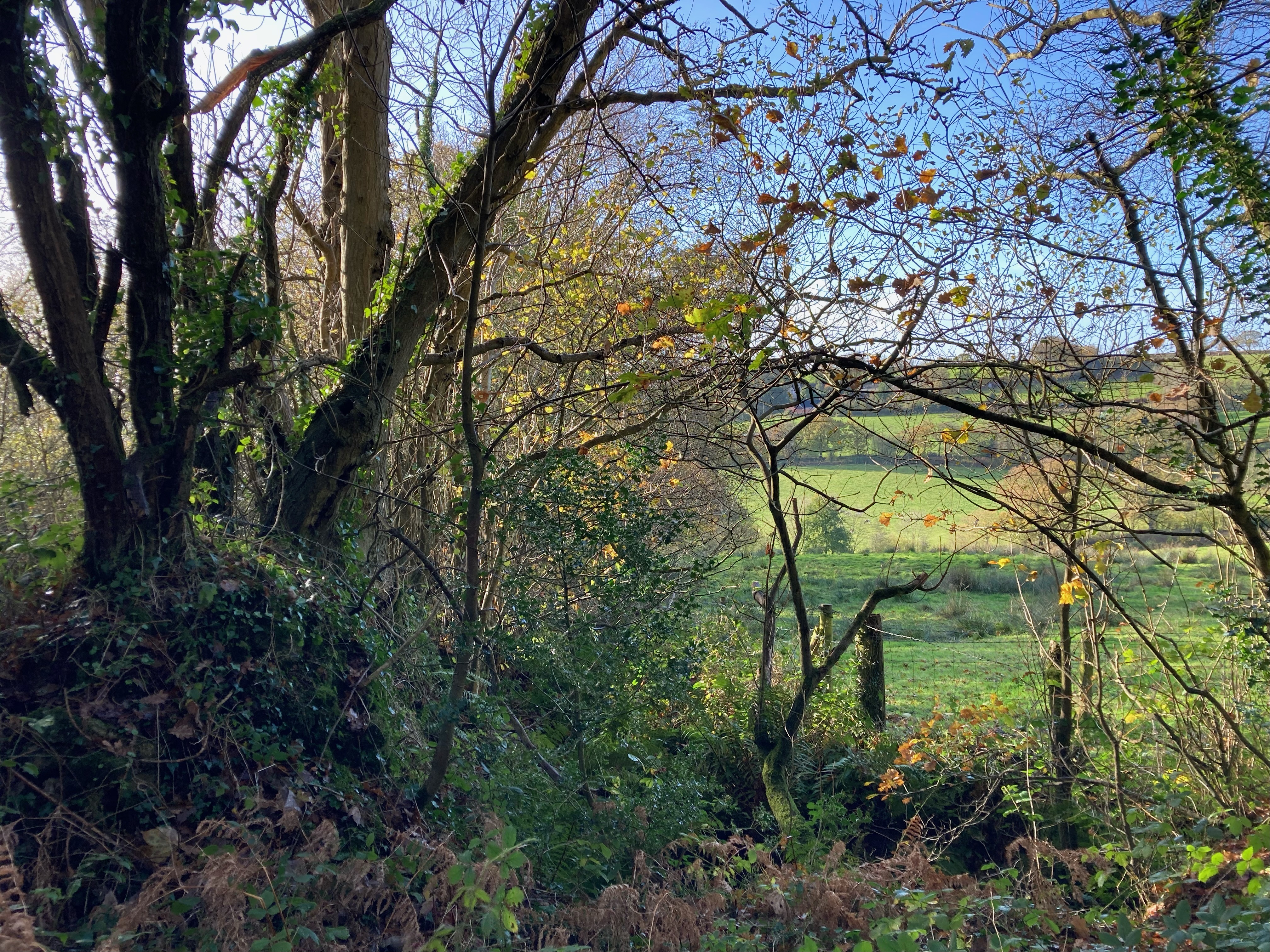
Driving back up to Applehayes, we parked again and set out across the fields behind to walk a modest circuit which would take us past a small wood. After crossing the fields, we returned past another farm to then change direction along a small ridge with woodland. We were looking for a flat skyline, with the delineation of field systems and hedgerows, but unsure of what the wood itself might look like after 100 years. We felt that we might be in the right area and soon noticed that the younger wood, consisting of birch and hazel gave way to oaks and other more mature trees. We quickly realised that we were looking across to a flat skyline across the valley, slightly obscured by trees, but there it was- similar field patterns in the distance and the edge of the wood in the foreground. The field shapes were almost identical to those depicted in the painting and although the wood was not quite how we expected it, the boundary and light seemed to all suggest that this was the spot. The longer we looked, the more confident we felt that we were in the right spot. The sense of relief was huge! Now, I could focus on how to interpret the location for my own piece.

Where Gore stood to paint ‘Edge of the Wood, Applehayes’

As Gore worked in colour and my work is monochrome, I felt that a different interpretation was really needed. If I was going to spend time on this, I needed something that would excite me. The trees in Gore’s picture were not really playing with the light as I would like, and Gore’s composition, although working well with his palette, was structurally uninteresting. However, a couple of ideas started to form. One would be to execute a quick study using a looser way of working which I had adopted during lockdown- which gave a sense of energy and movement. The other idea was to turn my back on the scene, to go to the oaks which stood behind us and work with those. The oaks felt precious, semi wild and would have sheltered Gore as he painted the scene. I could feel the sense that this was ‘right’ starting to flow. It would be two pictures, one ‘me’ and one ‘him’, back and forth across a century.

Paradise Found opens on 18 March with a preview

The Camden Town Group in Context

Thelma Hulbert Gallery- Paradise Found

#Art #ArtExhibition #ArtCollector #Nature #Environment #BlackdownHills #Devon #Somerset #Painting #Printmaking #Drawing #SpencerGore #Arboreal #Trees #Woodland #Wildlife #Ecology #Walking #SouthWestEngland #CamdenTownGroup #ArtHistory